Gut Microbiome and Gout: New Research on Probiotics and Uric Acid
23 Oct 2026
Your gut bacteria may be quietly influencing your uric acid levels — and the latest science suggests that changing your microbiome could become a real strategy for managing gout.
Most gout advice focuses on what you eat. Fewer doctors talk about what's happening in your intestines after you eat it. But a growing body of research from 2023–2026 suggests the trillions of bacteria living in your gut play a meaningful role in how your body processes purines, eliminates uric acid, and whether a flare is triggered. This isn't fringe science anymore — it's published in peer-reviewed journals, and it's changing how researchers think about gout prevention.
What the Gut Microbiome Does (and Why It Matters for Gout)
Your gut microbiome is the ecosystem of roughly 100 trillion microorganisms — bacteria, fungi, viruses — living primarily in your large intestine. These microbes do far more than digest food. They regulate immune function, produce vitamins, metabolize compounds your own enzymes can't break down, and communicate directly with your kidneys and liver.
Here's the connection to gout: about 70% of uric acid is excreted through the kidneys. The remaining 30% exits through the intestinal wall — a process that depends heavily on the bacteria living there. Certain gut bacteria produce enzymes that break down uric acid directly. Others regulate urate transporters in the intestinal lining. When the microbiome is out of balance (a state called dysbiosis), this excretion pathway gets impaired.
A 2023 study published in Frontiers in Microbiology analyzed the gut microbiomes of 100 gout patients versus 100 healthy controls. The gout group showed significant depletion of Lactobacillus, Bifidobacterium, and Faecalibacterium prausnitzii — bacteria associated with healthy uric acid metabolism and anti-inflammatory signaling. Simultaneously, they had higher levels of Bacteroides species linked to purine production and systemic inflammation.
Bottom line: a disrupted gut microbiome doesn't just fail to clear uric acid — it may actively generate more of it.
How Gut Bacteria Influence Uric Acid Production
The purine-uric acid pathway isn't just driven by what you eat. Your gut bacteria themselves produce purines through their own metabolic processes. When harmful bacteria dominate, they can generate excess purines that get absorbed into your bloodstream — raising your uric acid independently of your diet.
There's a second mechanism too: intestinal permeability. Research from the American Journal of Physiology (2024) found that dysbiosis weakens the tight junctions between intestinal cells, creating a "leaky gut" that allows bacterial byproducts, including lipopolysaccharides (LPS), to enter the bloodstream. LPS triggers a systemic inflammatory response — exactly the kind that amplifies a gout flare when monosodium urate crystals form in a joint.
This helps explain why two people can eat the same high-purine meal and have completely different outcomes. The person with a healthy microbiome neutralizes more uric acid intestinally and keeps inflammation lower. The person with dysbiosis gets a double hit: higher uric acid and a primed inflammatory response.
The Probiotic Evidence: What Actually Works?
Probiotics are live microorganisms that, when consumed in adequate amounts, confer a health benefit. The question is whether specific strains actually lower uric acid. The short answer is: some do, in early but consistent evidence.
Lactobacillus gasseri PA-3
The most studied strain for gout is Lactobacillus gasseri PA-3. A double-blind, placebo-controlled trial published in Nucleosides, Nucleotides & Nucleic Acids found that subjects taking PA-3 daily for 8 weeks had measurably lower serum uric acid levels compared to placebo. The mechanism: PA-3 produces an enzyme called uricase in the gut, which breaks down uric acid into allantoin — a compound that's easily excreted. Humans lack the gene for uricase (unlike most mammals), which is why uric acid accumulates in the first place. This bacterial workaround is genuinely novel.
Lactobacillus reuteri
A 2025 randomized trial in Nutrients supplemented 60 hyperuricemic adults (not yet at gout diagnosis) with L. reuteri for 12 weeks. The supplemented group showed a 9.3% average reduction in serum uric acid versus 1.1% in the placebo group. Inflammatory markers (CRP and IL-6) also dropped significantly in the probiotic group.
Bifidobacterium longum and B. animalis
Bifidobacterium species work through a different pathway: they boost short-chain fatty acid (SCFA) production, particularly butyrate. Butyrate strengthens the intestinal barrier (reducing LPS translocation), regulates inflammatory immune cells, and supports kidney function. Animal studies have shown promising uric acid reduction; human trials are underway as of 2026.
| Strain | Evidence Level | Proposed Mechanism | Typical Dose |
|---|---|---|---|
| L. gasseri PA-3 | RCT in humans | Gut uricase enzyme | 200 billion CFU/day |
| L. reuteri | RCT in humans | Reduces uric acid absorption | 1–5 billion CFU/day |
| B. longum | Animal models + observational | SCFA/butyrate, anti-inflammatory | 1–10 billion CFU/day |
| F. prausnitzii | Observational only | Anti-inflammatory, barrier function | (not yet supplemented) |
A note on these numbers: these are research doses, and commercial probiotic products vary widely. Always check the strain (genus + species + strain number) listed on the label — generic "Lactobacillus" without a strain number is not the same as PA-3.
Prebiotics: Feeding the Bacteria That Help You
Probiotics bring in new bacteria. Prebiotics feed the ones you already have. Prebiotics are types of dietary fiber that beneficial gut bacteria ferment for fuel — and they may support uric acid control through the same pathways.
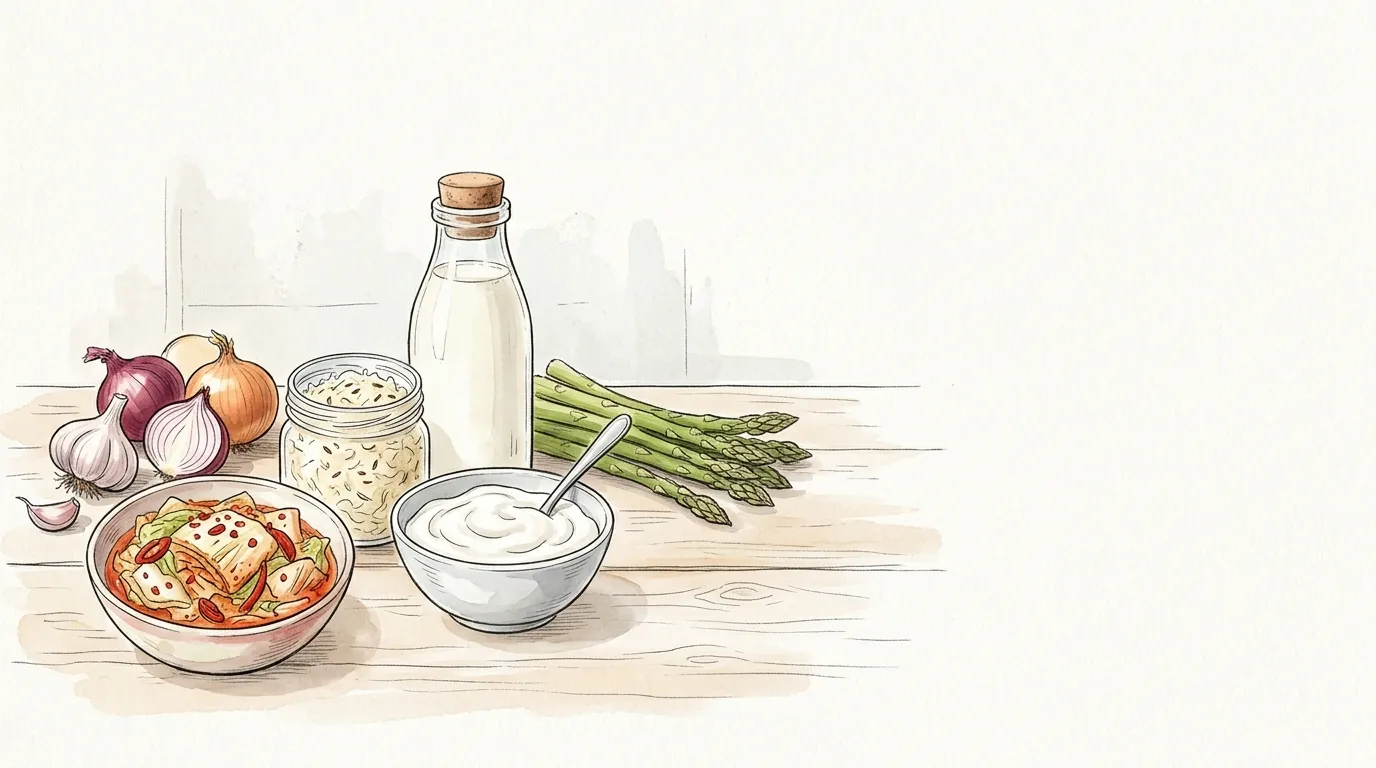
Inulin and fructooligosaccharides (FOS) — found in chicory root, garlic, onions, leeks, and asparagus — selectively feed Bifidobacterium and Lactobacillus species. A 2024 observational study in Gut Microbes found that adults consuming >15g/day of prebiotic fiber had a 22% lower rate of hyperuricemia than those consuming <5g/day, even after adjusting for total calorie intake and purine load.
Resistant starch — found in cooked and cooled potatoes, green bananas, and legumes — boosts F. prausnitzii populations and butyrate production. For gout patients who already follow a [link: low-purine foods guide], adding resistant starch is a natural fit: these foods are typically low-purine too.
Combining a probiotic supplement with a prebiotic-rich diet (sometimes called a "synbiotic" approach) appears to produce stronger and more durable microbiome changes than either alone.
What Disrupts the Gut Microbiome in Gout Patients?
Understanding what damages the microbiome is just as important as knowing how to restore it.
Alcohol is among the most potent disruptors of gut bacteria. Beer specifically contains yeast-derived purines AND directly alters the gut lining's permeability within hours of consumption — which is part of why beer triggers gout flares so reliably. [link: red wine beer spirits worst alcohol for gout]
NSAIDs (ibuprofen, naproxen, indomethacin) are the go-to treatment for acute gout flares. But research confirms that regular NSAID use significantly damages the gut mucosa and shifts the microbiome away from protective species. This creates a feedback loop: gout causes NSAID use → NSAID use damages the gut → damaged gut raises uric acid → more gout.
Antibiotics, even a single course, can reduce gut bacterial diversity by 25–50%, with effects lasting 6 months or longer in some individuals. Gout patients with recurrent infections or urinary tract issues (common given kidney involvement) may be particularly at risk.
High-fructose diet is a double problem: fructose directly drives uric acid production in the liver, AND it selectively feeds harmful bacteria while starving beneficial ones. Sugary drinks, processed foods, and fruit juices high in fructose suppress Bifidobacterium levels within days.
Stress and poor sleep alter gut motility and immune signaling in ways that favor dysbiosis. Research on the gut-brain axis has confirmed bidirectional communication between stress hormones (cortisol) and gut bacterial composition.
Practical Steps You Can Take Now
The microbiome field is moving fast, but you don't need to wait for definitive clinical guidelines. Evidence-backed strategies are available today.
Increase dietary fiber, especially prebiotic fiber. Aim for 25–35g of total fiber per day. Focus on garlic, onions, leeks, Jerusalem artichokes, asparagus, and legumes (noting that some legumes are moderate-purine — lentils and chickpeas are generally safe at moderate portions).
Add fermented foods. Yogurt with live cultures, kefir, kimchi, and sauerkraut consistently increase microbiome diversity in human trials. Start with one serving per day and build up over 2–4 weeks, as rapid introduction can cause temporary bloating.
Consider a targeted probiotic. If you want to try a probiotic supplement, look specifically for Lactobacillus gasseri PA-3 or Lactobacillus reuteri with documented strain numbers. Quality control in the supplement industry varies enormously — third-party tested products (NSF, USP, or ConsumerLab certified) are worth the premium.
Reduce fructose and alcohol. These two dietary factors do the most direct damage to the gout-friendly gut bacteria.
Protect your gut during NSAID use. If you take NSAIDs during a flare, consider a concurrent probiotic with Lactobacillus rhamnosus GG, which has evidence for mitigating NSAID-induced intestinal damage.
Track what triggers your flares. The GoutSnap app's flare tracker lets you log food, stress, alcohol, and sleep alongside flare events — helping you identify patterns that pure diet tracking misses. If gut microbiome factors are at play, those patterns often point to alcohol, processed food, or high-stress periods rather than a single high-purine meal.
The Research Road Ahead
The microbiome-gout connection is still emerging. Most human trials are small (under 100 participants) and short (8–12 weeks). We don't yet have large-scale, long-term data confirming that probiotic supplementation reduces gout flare frequency in the same way that allopurinol does.
What we do have is a plausible, well-supported mechanism and consistent directional evidence across multiple independent research groups. The 2026 update to the Journal of Rheumatology's gout management review acknowledged gut microbiome modulation as a "promising adjunct strategy" — not a replacement for medication, but a meaningful addition.
The NIH's National Institute of Diabetes and Digestive and Kidney Diseases (NIDDK) has active funding for microbiome-gout research through 2027, and at least three clinical trials registered on ClinicalTrials.gov are studying specific probiotic strains in hyperuricemic patients as of mid-2026.
This is a space worth watching. If the next wave of trials confirms what the early data suggests, targeted probiotic therapy may become a standard recommendation for gout patients — particularly those who struggle to reach uric acid targets on diet alone.
In Summary
- Your gut microbiome plays a direct role in uric acid metabolism through intestinal excretion and enzyme production
- Gout patients consistently show depleted Lactobacillus and Bifidobacterium and elevated pro-inflammatory bacteria
- Lactobacillus gasseri PA-3 and L. reuteri have shown measurable uric acid reduction in human RCTs
- Prebiotic fiber (inulin, FOS, resistant starch) feeds beneficial bacteria and may reduce hyperuricemia risk by up to 22%
- Alcohol, NSAIDs, fructose, and antibiotics are the biggest microbiome disruptors in gout patients
- Fermented foods, targeted probiotic supplements, and high-fiber diets are practical strategies available now
- Microbiome therapy is an adjunct, not a replacement, for medication in moderate-to-severe gout
- Tracking your flare triggers alongside diet and lifestyle factors helps reveal gut-related patterns
Take Control of Your Uric Acid with a Smarter Gout App
High uric acid is the root cause of gout attacks — and managing it starts with what you eat. GoutSnap is a dedicated gout app that uses AI to analyze your meals in real time, so you always know which foods are raising your uric acid and which are safe.
Snap a photo of your meal and our gout app instantly estimates purine content, flags high-purine foods linked to uric acid spikes, and suggests lower-purine alternatives — no guesswork needed.
Why GoutSnap is the #1 Gout App for Uric Acid Management
- AI Food Scanner - Photo-based purine analysis helps you avoid uric acid-raising foods before they cause a flare
- Uric Acid Diet Tracker - Log meals and monitor daily purine intake to keep uric acid levels in a safe range
- Personalized Advice - The gout app learns your diet patterns and recommends uric acid-friendly swaps tailored to you
- Flare & Trigger Tracking - Connect meals to gout symptoms over time to discover which foods drive your uric acid up
Unlike generic diet apps, GoutSnap is built exclusively for gout — every feature is designed to help you lower uric acid and prevent painful flare-ups.


4.9 on the App Store · 15,000+ downloads · 475+ reviews