Red Wine vs Beer vs Spirits: Which Alcohol Is Worst for Gout?
19 Oct 2026
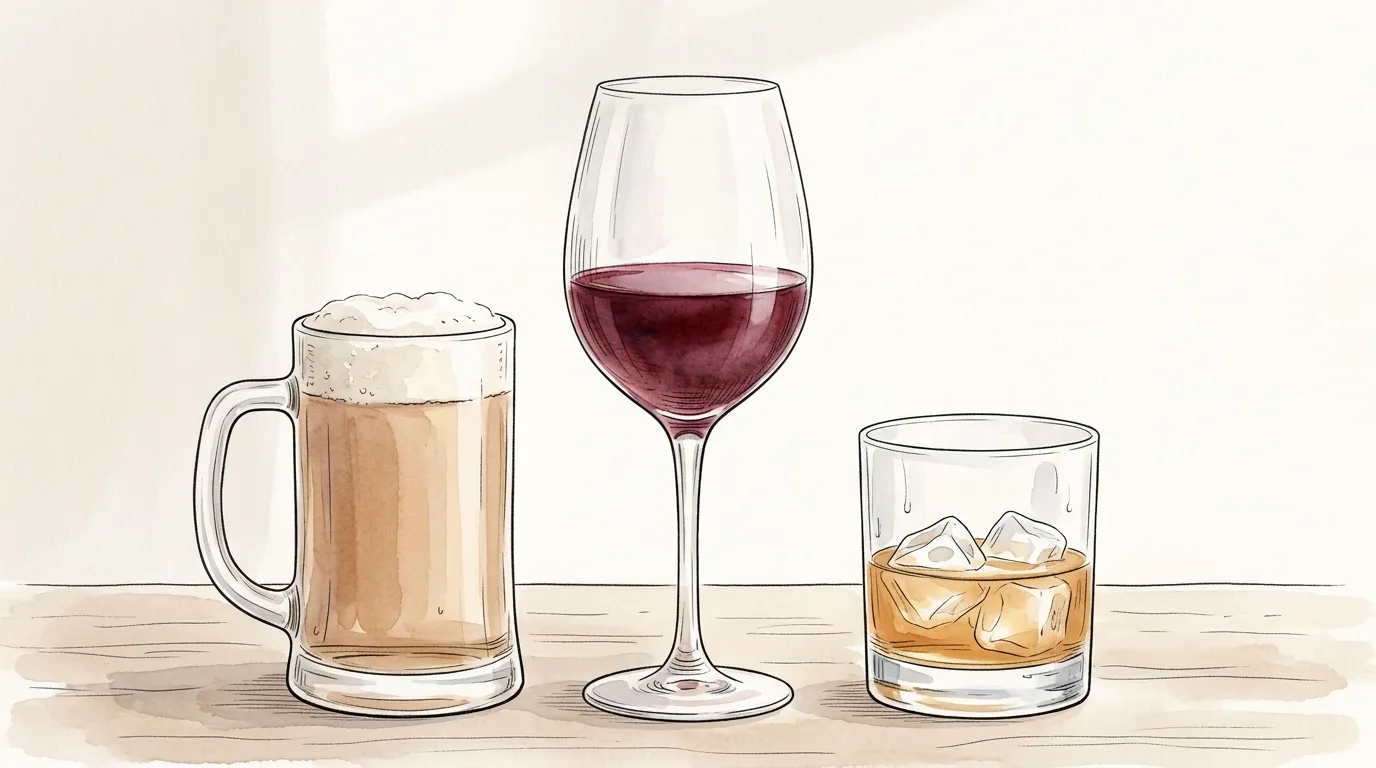
Beer is the worst alcohol you can drink if you have gout — it raises uric acid significantly more than wine or spirits. But that doesn't make red wine or whiskey safe. Every form of alcohol increases your gout risk, and the difference is really a matter of how much and how fast your uric acid spikes.
Understanding the hierarchy matters because blanket advice like "just avoid alcohol" is hard to follow, and knowing the real risk ranking helps you make smarter choices when a complete ban isn't realistic.
Why All Alcohol Raises Uric Acid
Before ranking the drinks, it helps to understand the mechanism. Alcohol raises uric acid through three separate pathways — and each one compounds the others.
Pathway 1: Alcohol metabolism competes with uric acid excretion. When your liver breaks down ethanol, it produces lactate. Elevated lactate levels compete with uric acid for excretion through the kidneys — so your body flushes less uric acid out, and blood levels climb. This happens with every type of alcohol.
Pathway 2: Alcohol accelerates purine breakdown. Ethanol increases the turnover of adenosine triphosphate (ATP) in your cells, producing more purine breakdown products — which your body converts to uric acid. The more alcohol you consume, the faster purines cycle, and the more uric acid is generated. A 2004 study published in The Lancet found that men who drank 2 or more servings of beer daily were 2.5 times more likely to develop gout than non-drinkers (Choi et al., The Lancet, 2004).
Pathway 3: Dehydration concentrates uric acid. Alcohol is a diuretic. It makes you urinate more than you drink, leaving you with less blood volume — which means the same amount of uric acid is now more concentrated in your bloodstream, raising the effective load on your joints.
The bottom line: No alcohol is "safe" for gout. The question is which type stacks these three pathways most aggressively.
Beer: The Worst Offender
Beer doubles down on the uric acid problem in a way wine and spirits simply don't.
On top of the three universal alcohol effects, beer contains significant dietary purines — specifically guanosine, a nucleoside found in yeast and malt. When yeast ferments barley and hops, it releases purine-rich compounds into the finished beer. Your body converts those directly to uric acid after drinking.
Here's a rough guide to purine content by beer type:
| Beer Type | Estimated Purine Content (mg/100 mL) |
|---|---|
| Regular lager | 5–8 mg |
| Dark/stout beer | 6–12 mg |
| Craft/IPA | 10–20 mg |
| Low-alcohol beer | 2–5 mg |
| Non-alcoholic beer | 1–4 mg |
Data sourced from USDA FoodData Central and Kaneko et al. (Nucleosides, Nucleotides & Nucleic Acids, 2014).
A typical 350 mL can of regular lager delivers roughly 17–28 mg of purines before the alcohol itself raises the total purine load through ATP metabolism. That same Lancet study found each additional beer per day was associated with a 1.49-fold increase in gout risk — significantly higher than the 1.15-fold increase from a single serving of spirits.
The research is clear: beer is 2–3× worse than wine for gout risk per serving.
Except… one more complication. Non-alcoholic beer is not safe either. It removes the ethanol but retains virtually all the yeast-derived purines. If you're reaching for a 0% beer thinking you're in the clear, you're still getting the purine load — just without the ethanol effect. Better than regular beer, but not risk-free.
Spirits: The Least Harmful Option — With a Catch
Distilled spirits — whiskey, vodka, gin, rum, tequila — contain virtually zero purines. The distillation process removes essentially all compounds other than ethanol, water, and trace flavor compounds. There are no malt purines, no yeast nucleosides, no fermented grain residue.
This is why spirits consistently show the lowest gout risk per drink in population studies. The Lancet study found spirits were associated with only a 1.15-fold increase in gout risk per serving — compared to 1.49 for beer.
But "least harmful" is not the same as "safe." Here's what the spirits category doesn't get credit for avoiding:
- The lactate-competition mechanism still applies. Your kidneys excrete less uric acid every time you drink spirits, even neat.
- Mixers matter enormously. A gin and tonic mixed with regular sugar-sweetened tonic water adds fructose — and dietary fructose is an independent driver of uric acid production, separate from purines entirely. A rum and Coca-Cola is effectively a double hit: alcohol plus high-fructose corn syrup. The NIH has documented the fructose-uric acid link extensively (Johnson et al., The American Journal of Clinical Nutrition, 2010).
- Volume negates the advantage. Three whiskies still exceed the dose where the cumulative ethanol effect overwhelms the purine advantage.
Safe spirit choices: Vodka, gin, or whiskey straight or on ice with soda water. Avoid sugary cocktails, energy drink mixers, and tropical juice blends (mango, pineapple, passionfruit — all high in fructose).
Red Wine: Complicated but Not Catastrophic
Red wine sits in an interesting middle ground. It has more supporting evidence for gout patients than any other type of alcohol — and also the most nuanced risk profile.
Red wine contains virtually no dietary purines. Grape fermentation doesn't release the same yeast nucleosides as grain fermentation. From a purine standpoint, red wine is closer to spirits than to beer.
Red wine may have modest uric acid-lowering effects from polyphenols. Resveratrol and other compounds in red wine are being studied for their potential to inhibit xanthine oxidase — the enzyme that converts purines to uric acid, and the same target as allopurinol. Early laboratory studies have shown promise, but clinical trial data in gout patients is still limited. Don't take this as permission to drink freely.
The Lancet study found wine did NOT significantly increase gout risk at moderate consumption levels (1–2 glasses/day). This was in stark contrast to beer and spirits. However, a separate analysis by the same team found that heavy wine consumption (>2 glasses/day) did elevate risk, consistent with the dose-dependent effect of ethanol itself.
| Drink | Gout Risk Per Serving (Relative) | Purines | Ethanol Effect |
|---|---|---|---|
| Beer (regular) | Highest (+49%/drink) | High | Yes |
| Spirits (neat) | Moderate (+15%/drink) | Negligible | Yes |
| Red wine | Low–Moderate (+0–10%/drink) | Negligible | Yes |
| White wine | Similar to red wine | Negligible | Yes |
| Non-alcoholic beer | Low-Moderate | Moderate | No |
Sources: Choi et al. (The Lancet, 2004); Choi & Curhan (Arthritis & Rheumatism, 2004).
Bottom line: If you're going to drink, a single glass of red wine with dinner is your lowest-risk option. But more than one glass per day still carries real risk — and during an active flare, no alcohol is appropriate.
What Happens During a Gout Flare
If you're already in a flare and you drink even one drink — any type — you are adding to active inflammation.
During a flare, uric acid crystals are already triggering an immune response in the joint. Alcohol further elevates serum uric acid levels within hours, potentially adding fresh crystals to an already inflamed space. Multiple studies have documented that alcohol consumption during a flare prolongs attack duration and increases pain intensity.
The ACR (American College of Rheumatology) 2020 guidelines are unambiguous: during an acute gout attack, alcohol of any type should be avoided entirely.
How to Drink (Less Badly) If You Choose To
For many people, eliminating alcohol entirely isn't realistic. Here's a practical harm-reduction framework based on the evidence:
1. Replace beer completely. This is the single biggest change you can make. Beer's dual purine-plus-ethanol effect makes it in a different risk category from wine or spirits. If you'd normally reach for a beer, try sparkling water or a mocktail instead. If you're social drinking, switch to a single glass of wine.
2. Hydrate aggressively around drinking. The dehydration mechanism is preventable. For every alcoholic drink, consume a large glass of water. Staying well-hydrated dilutes serum uric acid and supports kidney excretion — the [link: water intake and gout guide] explains the exact volumes that help.
3. Never drink on an empty stomach. Food slows alcohol absorption and blunts the lactate spike. Eating before and during drinking — especially low-purine foods like vegetables and dairy — reduces the acute uric acid effect.
4. Avoid sugary mixers. Fructose-sweetened drinks combine two independent uric acid drivers. Use soda water, fresh lime, or bitters instead of juice or tonic water.
5. Respect your medication. Allopurinol and febuxostat lower baseline uric acid, but alcohol can still trigger acute flares even when your uric acid is being managed. The drug doesn't eliminate the acute ethanol effect. [Link: allopurinol guide for gout patients]
6. Don't drink during a flare. Full stop. This is the one rule that's absolute.
Alcohol and Uric Acid Medications: A Note on Interactions
Alcohol doesn't just raise uric acid — it can interact with gout medications directly.
- Allopurinol + alcohol: No direct dangerous interaction, but alcohol can make flares more frequent and undermine the medication's effectiveness by repeatedly spiking uric acid. It may also increase allopurinol's effect on liver enzymes.
- NSAIDs (ibuprofen, naproxen) + alcohol: This combination increases the risk of stomach bleeding significantly. The ACR advises limiting alcohol while taking NSAIDs for flare management.
- Colchicine + alcohol: Both are processed by the liver. Heavy drinking while on colchicine may increase colchicine toxicity risk and can worsen nausea and GI symptoms.
Always check with your rheumatologist or pharmacist before mixing any gout medication with regular alcohol consumption.
Does Red Wine Really Lower Uric Acid?
This claim circulates online, often citing the resveratrol research. Let's be direct about what the evidence actually shows.
In vitro studies (lab cells): Resveratrol has shown some xanthine oxidase inhibition — meaning it may theoretically reduce uric acid production.
In human studies: The effect is small and inconsistent. A 2020 meta-analysis found that dietary resveratrol (from food, not supplements) had no significant effect on serum uric acid in most populations. The polyphenol content in a glass of red wine is too variable and too low to reliably impact uric acid levels at normal drinking quantities.
The bottom line: red wine's relative safety for gout comes from what it lacks (purines) more than what it contains (polyphenols). Don't drink red wine expecting it to lower your uric acid — drink slightly less fearfully because a single glass carries less risk than beer.
In Summary
- Beer is the worst alcohol for gout — it delivers dietary purines from yeast/malt plus the universal ethanol effect, raising uric acid through two pathways simultaneously.
- Spirits (neat) carry moderate risk — no dietary purines, but the ethanol still reduces uric acid excretion; sugary mixers add independent fructose risk.
- Red wine carries the lowest per-drink risk among alcoholic beverages, primarily because it lacks dietary purines; heavy consumption still raises uric acid.
- No alcohol is truly safe during a flare — the ACR recommends zero alcohol during acute attacks.
- The safest practical swap is replacing beer with a single glass of red wine, hydrating heavily, and avoiding sugar-sweetened mixers.
- Hydration is your most effective alcohol harm-reduction tool — water dilutes serum uric acid and supports kidney excretion.
- The fructose in sugary mixers (tonic water, sodas, juices) is an independent uric acid driver — avoid it whether you're drinking wine, spirits, or beer.
Take Control of Your Uric Acid with a Smarter Gout App
High uric acid is the root cause of gout attacks — and managing it starts with what you eat. GoutSnap is a dedicated gout app that uses AI to analyze your meals in real time, so you always know which foods are raising your uric acid and which are safe.
Snap a photo of your meal and our gout app instantly estimates purine content, flags high-purine foods linked to uric acid spikes, and suggests lower-purine alternatives — no guesswork needed.
Why GoutSnap is the #1 Gout App for Uric Acid Management
- AI Food Scanner - Photo-based purine analysis helps you avoid uric acid-raising foods before they cause a flare
- Uric Acid Diet Tracker - Log meals and monitor daily purine intake to keep uric acid levels in a safe range
- Personalized Advice - The gout app learns your diet patterns and recommends uric acid-friendly swaps tailored to you
- Flare & Trigger Tracking - Connect meals to gout symptoms over time to discover which foods drive your uric acid up
Unlike generic diet apps, GoutSnap is built exclusively for gout — every feature is designed to help you lower uric acid and prevent painful flare-ups.


4.9 on the App Store · 15,000+ downloads · 475+ reviews