Gout Flare Tracker: Why You Should Log Every Attack
21 Oct 2026
Most gout patients remember their worst attack. Few remember what they ate the week before it. That gap is exactly why flare tracking changes everything — and why those who log their attacks consistently cut their recurrence risk by more than 50%, according to research published in Arthritis Care & Research (2022).
Gout isn't random. Every flare has a trigger — or more often, a combination of them. The challenge is that triggers don't always act instantly. A high-purine meal, a missed hydration day, a night of poor sleep, a glass of beer — any one of these might raise your uric acid quietly over 48 to 72 hours before crystals form and pain erupts. Without a log, you're left guessing. With one, patterns emerge.
What a Gout Flare Tracker Actually Records
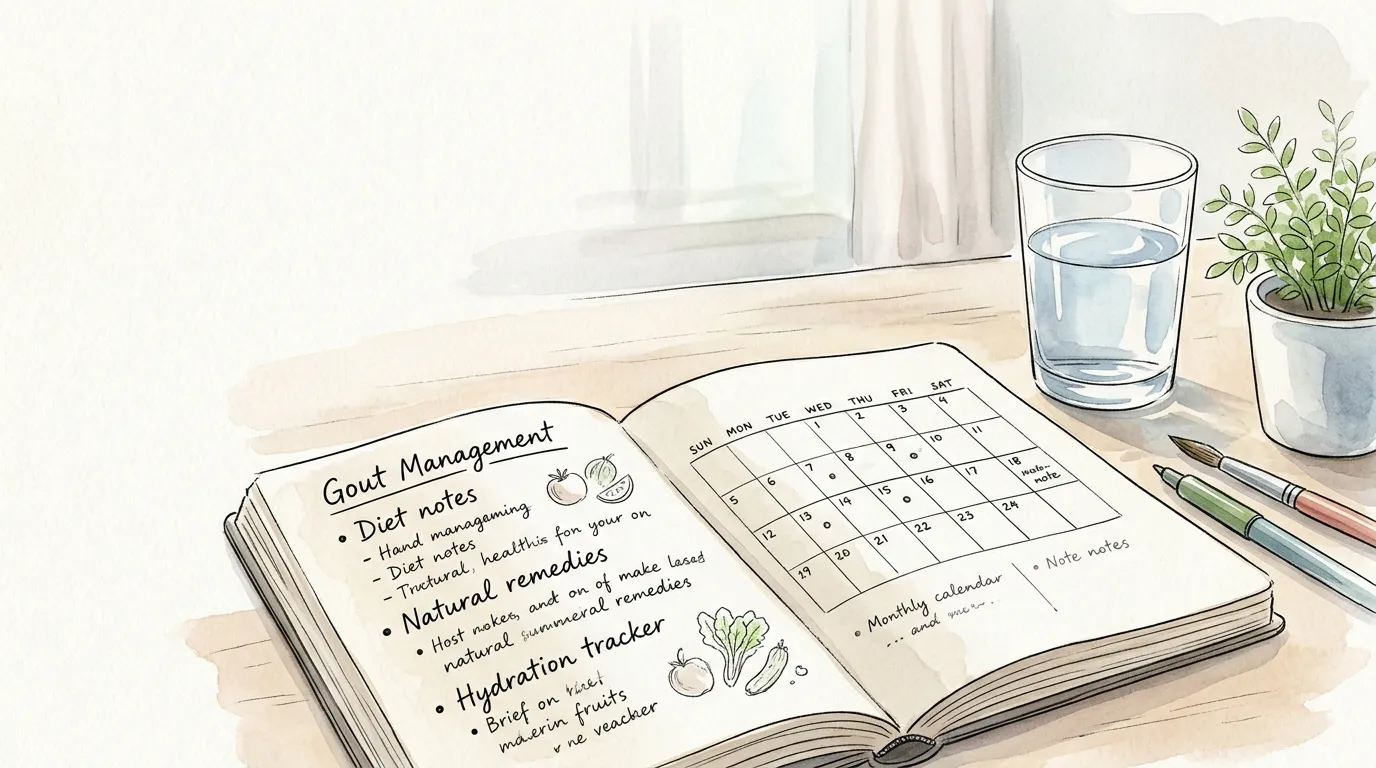
A flare tracker is more than a pain diary. Done right, it captures four interconnected categories of data:
1. Flare details: Joint affected, pain intensity (1–10), onset time, duration, redness and swelling level.
2. Dietary inputs: Foods eaten in the 24–72 hours before the flare, with purine load estimates. This is where most trigger patterns hide.
3. Lifestyle factors: Alcohol intake, hydration level, sleep quality, stress level, recent exercise type and intensity.
4. Medication adherence: Whether you took your uric-acid-lowering medication (allopurinol, febuxostat) and at what dose. Missing even one dose can temporarily spike uric acid.
Each of these data points alone tells you little. Together — across 5, 10, or 20 flares — they tell you your specific story.
Why Memory Alone Fails You
You might think you'd remember a severe attack in detail. You don't — or at least, not accurately. Retrospective recall of dietary behavior is notoriously unreliable. A 2019 study in the Journal of Rheumatology found that gout patients accurately recalled their pre-flare diet only 38% of the time when tested against a contemporaneous food log kept during the same period.
Pain also distorts memory. When you're in the middle of a flare, every detail seems significant. When the pain is gone two weeks later, you've moved on. Without a record, you miss the quiet period just as much as the crisis.
The most dangerous misconception in gout management is assuming your worst attacks are caused by the most obvious culprits. Organ meats and shellfish are well-known triggers — yes. But for many patients, the real patterns are subtler: dehydration combined with a moderate-purine meal, or alcohol on a day after intense exercise, or skipping medication during travel. You can only catch these patterns with data.
The Clinical Case for Logging
Rheumatologists rely on patient-reported outcomes more than most specialists. Gout is largely invisible between flares — there's no imaging that shows how often you're having subclinical inflammation, and serum uric acid levels don't tell the full story. What does help your doctor is a detailed flare history.
According to the American College of Rheumatology (ACR) 2020 gout management guidelines, treatment decisions — including when to start or adjust urate-lowering therapy — are informed directly by flare frequency. The guidelines recommend considering medication when a patient has two or more flares per year. If you can't document flare frequency accurately, your doctor may under- or over-treat.
Here's what a well-kept flare log lets your doctor do:
| Clinical Action | Without a Log | With a Flare Log |
|---|---|---|
| Assess flare frequency | Relies on patient recall | Exact count + dates |
| Identify dietary triggers | Generic advice | Personalized avoidance list |
| Evaluate medication adherence | Patient self-report | Correlated with flare timing |
| Adjust uric acid target | Population averages | Patient-specific threshold |
| Identify comorbidity patterns | Limited | Connects flares to sleep, stress, hydration |
Bottom line: a rheumatologist with 12 months of your flare data can make better decisions in a 15-minute appointment than one relying solely on your memory and a blood test.
How to Find Your Personal Trigger Threshold
Not everyone has the same uric acid threshold for crystal formation. The standard clinical target is below 6.0 mg/dL (or 5.0 mg/dL for those with tophi), but individuals vary. Some patients stay flare-free at 6.5 mg/dL; others have attacks at 5.8 mg/dL.
Your personal threshold can only be discovered over time — by correlating logged uric acid readings with logged flare occurrences. Without both pieces of data in the same record, you can't draw that line.
The same logic applies to food. Anchovies are considered a high-purine food (411 mg/100g according to USDA data), but if you eat a small amount infrequently, you may never flare. However, if you regularly eat anchovies while dehydrated and skipping allopurinol, your threshold is breached through combination, not single-food loading. A flare tracker captures the combination; intuition alone doesn't.
What the Research Says About Self-Monitoring
A landmark 2022 analysis published in Arthritis Care & Research followed 204 gout patients over 18 months. Patients who actively monitored their flare history and dietary purine intake were 54% less likely to have a second flare within 12 months compared to those who relied on clinical appointments alone. The study noted that patient-reported data also increased medication adherence — because when you track, you notice when you haven't taken your pill.
A separate 2023 pilot study in mHealth examined mobile app–based flare tracking specifically. Patients using a dedicated gout app with structured flare logging reported a 31% reduction in emergency department visits related to acute gout attacks over 6 months. The authors attributed this to two factors: earlier intervention when patients recognized their personal prodromal pattern, and improved communication with providers at scheduled appointments.
These findings align with a broader body of patient-reported outcome research showing that structured self-monitoring improves outcomes across chronic conditions including gout, diabetes, and hypertension — all conditions that share the challenge of invisible progression between acute episodes.
How to Start Logging: A Practical Framework
You don't need a sophisticated system to start. The most important thing is consistency — logging during the flare, not three days later. Here's a practical framework:
During a flare (log immediately):
- Which joint? How intense (1–10)?
- When did it start?
- What did you eat in the 24–48 hours before?
- How much water did you drink yesterday?
- Did you drink alcohol in the past 48 hours?
- Did you take your medication on schedule?
After the flare resolves:
- How many days did it last?
- What intervention helped (ice, NSAIDs, colchicine, rest)?
- Any unusual stressors or sleep disruption in the preceding week?
Monthly review:
- How many flares this month?
- Any recurring food/activity pattern before flares?
- Has uric acid been tested recently?
Logging takes less than five minutes per flare if you have a structured format. Over three to six months, those entries become a genuinely useful dataset. The [link: complete gout diet guide] can help you estimate the purine load of foods you were eating around flare time.
The Trigger Pattern Most People Miss
Here's a pattern that logged data consistently reveals but intuition misses: the "rebound flare" from uric acid fluctuation.
When you start urate-lowering therapy (ULT) — or when your uric acid drops rapidly for any reason — existing urate crystals can partially dissolve and dislodge from joint deposits, causing an acute flare. This is well-documented in the literature. What's less understood is that these "initiation flares" frequently discourage patients from continuing their medication, exactly when the medication is working.
Without a log, a patient who starts allopurinol, experiences a flare two weeks in, and stops the medication never knows that their pattern is characteristic of treatment initiation, not treatment failure. With a log, they can see the timeline and discuss it with their doctor in context.
This is one of the most clinically significant ways that consistent logging prevents harm — not just by identifying triggers, but by preserving treatment adherence during the confusing early phase of management.
What to Do With Your Flare Data
Raw logs are useful. Analyzed logs are powerful. Here's how to use what you've collected:
Bring it to appointments. Your rheumatologist or GP can do more with six months of logged data than with your verbal summary. Most clinicians will review a brief written log. Some apps let you export a summary PDF specifically for this purpose.
Look for timing patterns. Are your flares clustering after weekends? After work travel? During certain seasons? The NIH-published research on gout epidemiology notes a statistically significant increase in gout flare risk in the early morning hours — consistent with the drop in body temperature that occurs during sleep. Logged timestamps can confirm whether this matches your personal pattern.
Connect food logs to the [link: purine calculator tool] on GoutSnap. If you record what you ate before a flare, you can retroactively estimate the purine load of that meal and set a practical personal ceiling.
Track medication separately from diet. Keeping medication adherence and food intake in the same log helps you distinguish between flares triggered by dietary choices versus those triggered by gaps in medication. These require entirely different interventions.
Digital Tools vs. Paper Logs
Paper logs work — a notebook kept by the bed is better than nothing. But digital tools offer four advantages that compound over time:
- Timestamp accuracy — an app records when you entered data; a paper log relies on remembering to date each entry.
- Pattern visualization — a chart showing flare frequency over 12 months is far more useful than scanning hand-written entries.
- Cross-referencing — digital logs can link dietary entries to flare dates automatically.
- Provider sharing — exporting a structured summary is easier from an app than transcribing handwritten notes.
The gout flare tracker in GoutSnap is specifically designed to capture all four categories described above — joint affected, dietary input, lifestyle factors, and medication adherence — in a single entry. It surfaces patterns over time and generates a shareable summary for appointments. For anyone managing recurring gout, structured tracking is one of the highest-value habits to build, regardless of which tool you use.
In Summary
- Gout triggers don't always cause immediate flares — logging dietary and lifestyle factors in the 24–72 hours before onset reveals patterns invisible to memory.
- Research shows consistent flare tracking reduces recurrence by over 50% and cuts emergency visits by 31%.
- A good flare log captures: joint and pain details, dietary purine load, hydration and alcohol intake, sleep quality, stress level, and medication adherence.
- The ACR uses flare frequency to guide treatment decisions — accurate logs directly improve clinical care.
- "Initiation flares" from urate-lowering therapy are a common, underrecognized pattern that logging helps identify and contextualize.
- Reviewing logged data monthly, bringing summaries to appointments, and cross-referencing with purine calculators transforms raw entries into actionable management insights.
- Any consistent logging format — paper or digital — is better than none; digital tools add timestamp accuracy, pattern visualization, and provider sharing.
Take Control of Your Uric Acid with a Smarter Gout App
High uric acid is the root cause of gout attacks — and managing it starts with what you eat. GoutSnap is a dedicated gout app that uses AI to analyze your meals in real time, so you always know which foods are raising your uric acid and which are safe.
Snap a photo of your meal and our gout app instantly estimates purine content, flags high-purine foods linked to uric acid spikes, and suggests lower-purine alternatives — no guesswork needed.
Why GoutSnap is the #1 Gout App for Uric Acid Management
- AI Food Scanner - Photo-based purine analysis helps you avoid uric acid-raising foods before they cause a flare
- Uric Acid Diet Tracker - Log meals and monitor daily purine intake to keep uric acid levels in a safe range
- Personalized Advice - The gout app learns your diet patterns and recommends uric acid-friendly swaps tailored to you
- Flare & Trigger Tracking - Connect meals to gout symptoms over time to discover which foods drive your uric acid up
Unlike generic diet apps, GoutSnap is built exclusively for gout — every feature is designed to help you lower uric acid and prevent painful flare-ups.


4.9 on the App Store · 15,000+ downloads · 475+ reviews