How to Use a Gout Tracking App to Prevent Flares
02 Oct 2026
A gout tracking app can cut your flare frequency in half — but only if you use it consistently and correctly. The difference between someone who still gets monthly attacks and someone who goes years without one often comes down to data: are you recording what triggers your flares, or are you guessing?
Most gout patients underestimate how much variation exists in their personal triggers. What spikes your uric acid may not be the same as what spikes your neighbor's. A tracking app closes that gap by turning your experience into evidence.
Why Guesswork Keeps Gout Patients Stuck
You already know the standard advice: avoid organ meats, skip beer, drink more water. That list comes from population-level research, and it's a starting point — not a personalized plan.
The problem is that gout triggers are deeply individual. A 2021 study published in Arthritis & Rheumatology found that among gout patients who kept detailed food diaries for 12 months, the foods most predictive of flares varied significantly from person to person. Beer was a universal risk factor; beyond that, individual variation was high.
Translation: you need your own data, not just the average data.
This is where systematic tracking changes everything. Instead of relying on memory (unreliable) or general guidelines (incomplete), you build a personal profile of what your body responds to.
What a Gout Tracking App Actually Tracks
A well-designed gout app monitors multiple inputs simultaneously, because flares are rarely caused by a single factor.
Food and drink: This is the most obvious input. Every meal you log gets analyzed for purine content — the compounds that break down into uric acid in your blood. High-purine foods like anchovies (411 mg/100g), beef liver (554 mg/100g), and mussels (154 mg/100g) are clear targets. But so are fructose-heavy drinks, which the NIH has linked to elevated uric acid levels independent of purine intake.
Fluid intake: Dehydration concentrates uric acid in the blood. Tracking your daily water consumption — even roughly — helps connect the dots between dry days and flare days.
Medications: If you take allopurinol or febuxostat, logging your doses reveals whether missed doses correlate with increased pain. Many patients are surprised by how often a late or skipped dose precedes a flare by 48–72 hours.
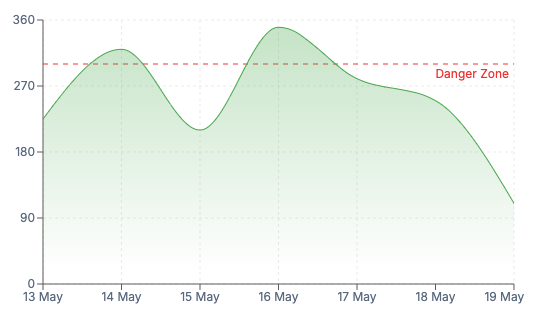
Pain and flare events: Rating your joint pain (1–10) each day creates a timeline. When you plot pain levels against food logs, medication records, and water intake, patterns emerge that would otherwise stay invisible.
Lifestyle factors: Sleep quality, stress levels, and physical activity all influence uric acid. [link: stress triggers gout flares] Adding a quick daily entry on these factors gives your data set depth.
How to Set Up Your Tracking for Maximum Usefulness
Starting a tracking habit is easy. Sustaining it long enough to generate actionable insights takes structure.
Log in real time, not at the end of the day
Memory degrades fast. A meal you ate at noon feels vague by 9 p.m. The most accurate logs happen immediately — photo a plate, note the portion, move on. Apps with a visual food scanner make this nearly frictionless: point your phone at the dish and get instant purine data, rather than hunting through a manual database.
Rate your pain every single day — even when you feel fine
Zero-pain days are as informative as pain days. They tell you what you ate and did when your uric acid was under control. Gaps in your log create holes in the pattern.
Use consistent portion estimates
You don't need a food scale. "Deck of cards" for meat (about 85g), "tennis ball" for pasta, "golf ball" for nuts are rough but consistent. Consistent estimates are far more useful than alternating between precise measurements and vague guesses.
Set a minimum 30-day goal before drawing conclusions
Uric acid builds up in tissues over days and weeks. A single meal rarely causes a flare in isolation; it's cumulative load that tips you over the threshold. Give your tracking data at least a month before making diet changes based on it. Sixty to ninety days is better.
Reading Your Data: How to Spot Your Personal Triggers
Once you have several weeks of logs, patterns become visible. Here's how to interpret them.
The 24–72 hour window
Most gout flares don't start at the moment of the trigger. There's a lag of 24 to 72 hours between a uric acid spike and crystal formation in a joint. So when a flare starts Monday morning, look at what you ate and drank Friday through Sunday — not Monday breakfast.
This delay is why gut instinct fails. People blame the last meal they ate before the flare, when the actual culprit was two days earlier.
Look for the combination, not just the culprit food
A common pattern in tracking data: a moderately high-purine meal on its own doesn't cause a flare. But the same meal plus alcohol plus poor sleep in the same 48-hour window does. No single variable is the trigger — the combination is.
Your app's log lets you cross-reference all three. After a flare, scroll back 48–72 hours. What was your pain score before it started climbing? What did the preceding meals look like? Did you drink less water that day? Were you stressed or sleep-deprived?
Purine load table for common high-risk foods
| Food | Purine Content (mg/100g) | Flare Risk Level |
|---|---|---|
| Beef liver | 554 | Very High |
| Anchovies | 411 | Very High |
| Sardines | 345 | Very High |
| Mussels | 154 | High |
| Salmon | 170 | High |
| Shrimp | 147 | High |
| Beef (lean) | 110–133 | Moderate |
| Chicken breast | 115 | Moderate |
| Lentils (cooked) | 50 | Low-Moderate |
| Tofu | 68 | Low-Moderate |
| Spinach | 97 | Low (plant source — lower bioavailability) |
Sources: USDA Food Data Central, Arthritis Foundation Purine Content Reference (2024)
Note: Plant-based purines (spinach, lentils, asparagus) are generally absorbed and converted to uric acid less efficiently than animal-based purines. Don't treat the raw numbers as equivalent. [link: low-purine foods guide]
How Tracking Reduces Flares Over Time
The mechanism isn't magic — it's behavioral feedback.
When you can see that your worst pain weeks follow specific patterns, motivation to change those patterns becomes concrete rather than abstract. "Avoid organ meats" is advice. "Your flares consistently follow weekends when you had two beers and skipped your morning water" is your own evidence — and it's harder to ignore.
A 2020 review in Current Rheumatology Reports found that gout patients who received personalized dietary feedback (vs. generic advice) showed significantly greater reductions in serum uric acid over 6 months. The tracking isn't just for awareness — the act of logging changes behavior.
The American College of Rheumatology (ACR) 2020 Gout Guidelines also emphasize patient education and self-monitoring as components of effective long-term management, noting that lifestyle modification has to be individualized to be effective.
What to Do When a Pattern Emerges
Suppose your data shows a clear pattern: flares cluster within 48–72 hours of high-seafood meals. Here's the practical next step.
Don't eliminate the food entirely right away. Instead, test the threshold. Try the same seafood in a smaller portion. Log it. Add extra hydration around that meal. Track whether the flare still follows.
Many gout patients find they have a personal tolerance threshold — a portion size or frequency below which a given food doesn't cause problems. The only way to find that threshold is controlled, logged experimentation.
If eliminating a suspected trigger for 2–3 weeks and then reintroducing it produces a flare, you have near-causal evidence — not a definitive clinical trial, but actionable personal data.

The Role of Medication Tracking
Diet tracking gets most of the attention, but medication consistency is equally important — arguably more so if you're on urate-lowering therapy (ULT) like allopurinol.
The goal of allopurinol is to keep your serum uric acid below 6 mg/dL (or below 5 mg/dL for patients with tophaceous gout, per ACR guidelines). But that target only stays stable with consistent daily dosing. Missing even two or three doses a week can let uric acid creep upward — and the effect may not show up as a flare until weeks later.
Tracking missed doses alongside pain levels often reveals a lag effect that patients don't notice without the data. If you see a pattern where your pain scores start rising 10–14 days after a stretch of inconsistent medication use, that's your evidence to take consistency more seriously.
Building the Habit: Making Daily Logging Stick
Tracking fails when it feels like homework. Here are practical strategies to keep it going.
Attach logging to an existing habit. Log your meals right after you eat, not later. Log your pain score when you brush your teeth at night. The habit stacks onto something you already do.
Set a 2-minute rule. Your daily log entry should never take longer than 2 minutes. If it does, you're over-engineering it. Quick ratings and broad food categories are enough.
Review your data weekly, not daily. Daily fluctuations can feel discouraging or confusing. A weekly review — 10 minutes on Sunday — lets you see the trends clearly.
Don't be a perfectionist about missed days. A log with 3–4 gaps per month is still highly useful. Quit the all-or-nothing thinking; consistency over perfection.
When to Share Your Data with Your Doctor
Your tracking data has clinical value — especially if you see your rheumatologist every 3–6 months. Before your appointment:
- Export or screenshot your pain trend over the past 60–90 days
- Note any consistent pre-flare patterns you've identified
- Flag any medications with missed doses during high-pain periods
Doctors can adjust dosing, suggest additional testing (serum uric acid, kidney function), or confirm whether your self-identified triggers align with the clinical picture. Your personal data supplements their clinical tools.
In Summary
- Gout tracking apps work by turning vague patterns into personal, actionable evidence
- Log food, hydration, medication, pain, and lifestyle factors daily — even on good days
- The trigger-to-flare lag is 24–72 hours; look back in time, not at your last meal
- Plant-based purines are less risky than animal-based purines at the same mg count
- Medication consistency matters as much as diet; track both
- Review data weekly to spot patterns; adjust your diet in controlled experiments, not all at once
- Share your tracked data with your rheumatologist to improve your treatment plan
Take Control of Your Uric Acid with a Smarter Gout App
High uric acid is the root cause of gout attacks — and managing it starts with what you eat. GoutSnap is a dedicated gout app that uses AI to analyze your meals in real time, so you always know which foods are raising your uric acid and which are safe.
Snap a photo of your meal and our gout app instantly estimates purine content, flags high-purine foods linked to uric acid spikes, and suggests lower-purine alternatives — no guesswork needed.
Why GoutSnap is the #1 Gout App for Uric Acid Management
- AI Food Scanner - Photo-based purine analysis helps you avoid uric acid-raising foods before they cause a flare
- Uric Acid Diet Tracker - Log meals and monitor daily purine intake to keep uric acid levels in a safe range
- Personalized Advice - The gout app learns your diet patterns and recommends uric acid-friendly swaps tailored to you
- Flare & Trigger Tracking - Connect meals to gout symptoms over time to discover which foods drive your uric acid up
Unlike generic diet apps, GoutSnap is built exclusively for gout — every feature is designed to help you lower uric acid and prevent painful flare-ups.


4.9 on the App Store · 15,000+ downloads · 475+ reviews